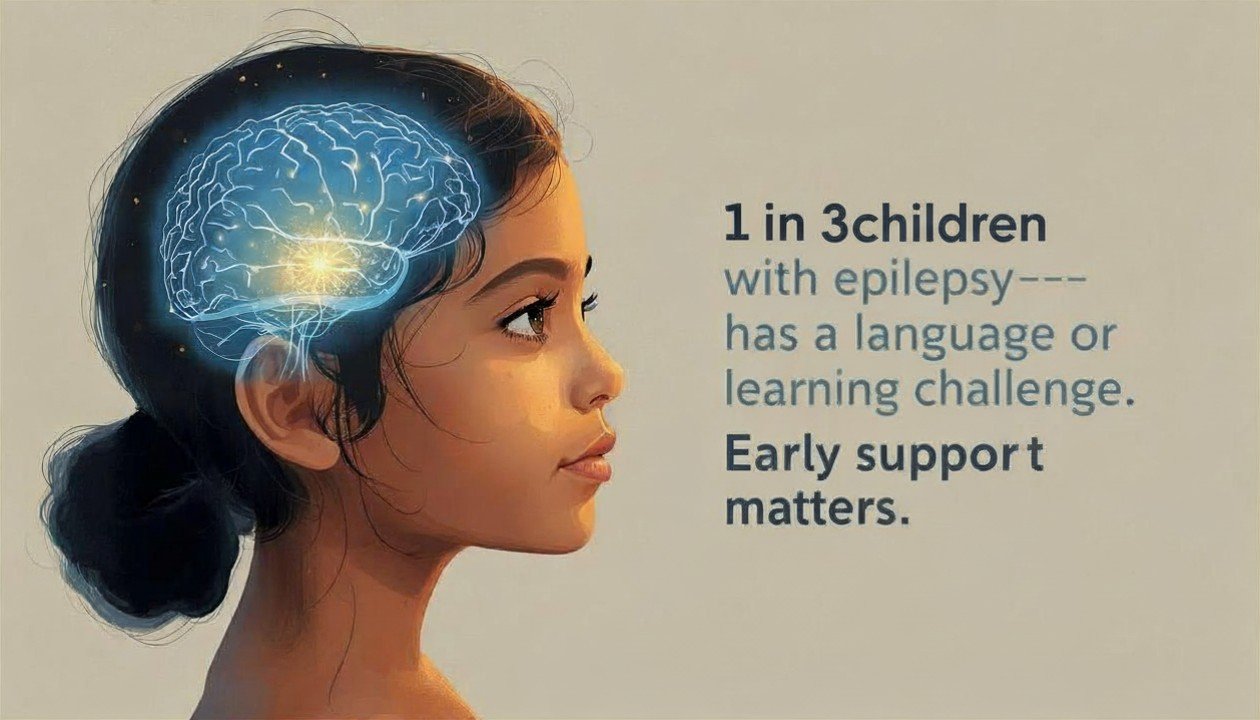
When a child is diagnosed with epilepsy, the immediate focus is understandably on seizure management — medications, triggers, safety plans. But for many families, there is a second layer of challenges that quietly builds over time and rarely gets the attention it deserves: the impact of epilepsy on speech, language, and learning.
As a speech-language pathologist with both personal and professional experience in this area, this is a topic I feel deeply passionate about. Children with epilepsy deserve support that addresses the whole picture — not just the neurological piece.
What the Research Tells Us
Depending on the type of epilepsy, the location of seizure activity in the brain, the frequency of seizures, and the effects of anti-epileptic medications, children can experience a wide range of cognitive and communication challenges.
Some of the most common communication and learning impacts include:
Word-Finding Difficulties
Children with epilepsy frequently experience anomia — the frustrating experience of knowing what you want to say but being unable to retrieve the word. This can look like long pauses mid-sentence, substituting vague words like "thing" or "stuff," or talking around a word they cannot access. It is often dismissed as a quirk or a confidence issue when it is actually a neurologically-based language challenge that responds well to targeted therapy.
Memory and Processing Challenges
Seizure activity — even absence seizures that last only seconds — can disrupt the encoding and retrieval of information. Children may struggle to follow multi-step directions, retain what they learned earlier in the day, or process spoken language at a typical pace. In a classroom environment, these challenges can significantly affect learning without ever being formally identified.
Slower Language Development
For some children, particularly those with early-onset epilepsy, language development may be delayed or disrupted during critical windows. Vocabulary growth, sentence structure, narrative skills, and the ability to use language flexibly in conversation can all be affected. Early identification and intervention in these areas can make a meaningful difference in long-term outcomes.
Reading and Literacy Difficulties
The relationship between language and literacy is direct and well-established. When foundational language skills are disrupted — phonological awareness, verbal memory, processing speed — reading and writing are affected too. Children with epilepsy are at elevated risk for literacy challenges that are neurological in origin, not motivational, and that deserve a structured, evidence-based response.
What Parents Can Do
If your child has epilepsy and you have noticed any of the following, a speech-language evaluation is worth pursuing:
Struggling to find words or frequently losing their train of thought
Difficulty following directions or remembering instructions
Slower processing — needing extra time to respond in conversation or class
Reading or spelling that is not keeping pace with peers
A change in communication skills after a seizure event or medication change
These observations matter. You know your child. If something feels different, it is worth investigating — not waiting to see if it resolves on its own.
You Do Not Have to Figure This Out Alone
ThinkSpeech Therapy works with children, teens, and adults affected by epilepsy-related communication and learning challenges in Northern Virginia and via telehealth across Virginia. My commitment to this community goes beyond the therapy room. I had the honor of advocating for the Seizure Safe Schools Act in Virginia — legislation that is deeply personal to me as someone with a family member affected by epilepsy. Ensuring that children with epilepsy are safe, supported, and fully seen at school — academically and communicatively — is something I care about with my whole heart. If you are noticing language or learning difficulties in your child and want to understand what is happening and what can be done, we would love to connect.